I'm not a casino
Books
What Thinking in Bets changed about how I run a pipeline call
 Anu Bulusu
5 min read
Thinking in Bets gave me two ideas that changed how I operate. One came straight from the book. The other came from where the book stops.
The idea at full strength
Annie Duke played professional poker for about two decades before she wrote it, and the book treats every decision as a bet: you're wagering on one version of the future with incomplete information and some luck in the mix. Her central warning is about resulting, which means judging a decision by how it turned out. Good decisions sometimes lose, and bad ones sometimes win. If you only look at the scoreboard, you learn the wrong lessons.
That's the book. Here's what it did to how I operate.
What it changed for me at work
Resulting worked on me in two directions.
The first was permission. Once I separated the decision from the outcome, I could try plays that were slightly off the usual script. If one didn't land, it wasn't automatically a mistake. The question was whether the reasoning held up given what we knew when we made the call.
That also changed how I empowered leaders in the organization. When outcomes are the only measure, every miss turns into a hunt for someone to blame, and people learn to make only the safe calls. So we started reviewing the process instead: was the call reasonable given what the leader knew at the time? If the reasoning was sound, we didn't punish the leader just because the outcome was bad. Execution was a separate question, since a good call can still be carried out badly. The blame game went away, and learning replaced it. A process can be improved. A bad roll of the dice can't.
The second direction was discipline. Resulting made me stop plays that were working.
We had a stretch where discounts closed deals, so we kept offering them. Every signed contract looked like proof that the discount was the right call. That's resulting in its purest form: the win got credited to the decision.
Eventually the question on our pipeline calls became a blunt one: has discounting become a crutch? For a boutique consulting firm, few questions matter more. A boutique sells on value, on expertise the buyer can't easily find elsewhere. Once you sell on price, you're in a race to the bottom against firms built to be cheaper than you. The deals had closed, but the decision behind them was pulling us toward competing on price. We stopped.
Where it breaks for an operator
The second idea comes from where the book stops, and it shows up on every pipeline call ever.
A poker player gets the long run. A good bet that loses tonight is fine, because the same bet made ten thousand times pays off. I don't get that. I don't get married a thousand times. I don't pivot a business a billion times. The math term for this is ergodicity: the average across many players tells you very little about one player living through the sequence. A casino lives on the average. An operator lives in the sequence.
Now think about a pipeline call, the regular meeting where a sales team reviews deals that haven't signed yet. Each deal gets a probability based on how far along it is: a deal where you've given a demo might sit at 25%, one where you've submitted a proposal at 50%, and so on up the stages. A deal at 50% goes into the forecast at half its value. Add up the column, and that's the number.
The math is fine. The problem is what the number hides. That 50% is a rule of thumb for the stage, applied the same way to every deal that reaches it, and deals vary in ways no percentage captures. Most services pipelines also aren't made of similar deals.
We had exactly this once. Dozens of deals between $50K and $200K, and three or four around $1M. Each big deal was worth five to twenty of the smaller ones. Put those four at 50%, and they add $2M to the forecast on their own. The forecast showed a tidy $2M. The reality was going to be anywhere from nothing to $4M, because each big deal would land in full or not at all. Four deals were steering a projection built on dozens, and the weighted number told us nothing about which way they'd go.
A $1M deal closes or it doesn't, and payroll doesn't care about the weighted average.
The weighted pipeline is the casino's view. Duke would ask whether each deal is a good bet. The question I needed was different: if the big one slips, can we absorb it.
With those four deals, hiring ahead of them was the risky part. So I changed the terms. If one of the big deals closed, the project would start 30 days later. Most clients were fine with it, since they needed the time to prepare too. We used that month to send our discovery questionnaires, so by kickoff both sides were working from better information.
The same month let us staff up after the contract was signed, so we never paid consultants to sit idle waiting on a deal that hadn't landed. If a big deal slipped, we lost the sale, and payroll was untouched. If it closed, we had time to build the team.
You can't forecast a $1M deal into certainty. You can change what it costs you when it doesn't close.
None of this makes Duke wrong. Resulting is real, and separating decisions from outcomes will make you a fairer leader. The card table just hides a second question.
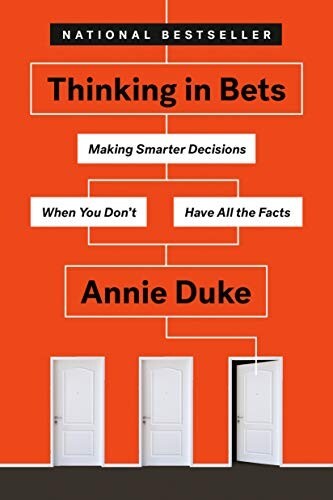
If I'd written this book, I'd have called it
Can You Absorb It?
Read, skim or skip
- Read it
- if you lead people or sign off on forecasts.
- Skim it
- if you already think in probabilities; the first chapter carries the core idea.
- Skip it
- only if you want poker strategy. The cards are a metaphor here.